Brick’s Marketing Strategy: How a Product-First Brand Engineered Coordinated Virality
Everyone and their mom is talking about Brick right now.
The product’s been floating around for a while, but recently it’s gone from a “that’s interesting” moment to a full-on movement. You see it in ads, then you hear it in conversation, and suddenly your friend casually drops, “I bricked my phone this weekend,” like that’s a completely normal sentence.
That kind of momentum doesn’t happen by accident. And it definitely doesn’t happen from ads alone.
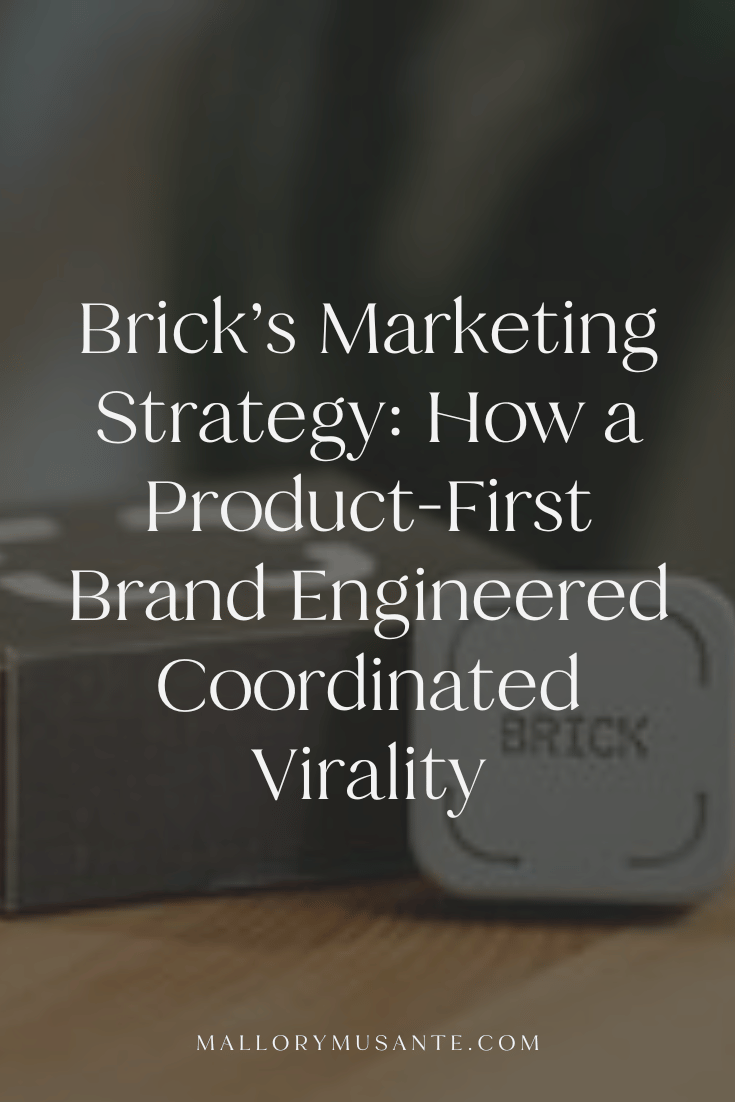
So let’s break down what Brick’s doing so well and how they’ve engineered this moment by leaning all the way into being a product-first brand.
Brick Is a Product-First Brand
The most important thing to understand about Brick’s success is that it starts, and ends, with the product.
They clearly took the time to deeply understand their audience — the burnout, the guilt, the “I should be more disciplined” spiral that comes with phone addiction. And they realized setting time limits weren’t actually helping people. And they realized setting time limits weren’t actually helping people.
So they came up with a solution. And not just any solution. One that actually worked and helped people reduce screen time, ultimately breaking their phone addiction habits.
That’s why the product speaks for itself. When something delivers immediate, noticeable relief from a real frustration, people don’t need to be convinced. They talk about it naturally. They recommend it unprompted. They jump into comment sections to validate it for strangers.
That’s where the viral quality of Brick comes from.
That is the foundation the rest of their marketing (and frankly, company) is built on.
They put product above all, knowing that if it changes someone’s life they’d become a brand advocate for life.
Turning the Brand Name Into a Verb
This is one of the smartest plays of their brand strategy.
Because the phrase “Brick your phone.” is doing an enormous amount of work for them.
It’s memorable. A little funny. Easy to say and remember. Makes people curious when they hear the phrase if they haven’t heard it before. And you pretty much immediately understand what’s happening: your phone becomes a brick—useless, inert, incapable of stealing your attention.
This matters for brand awareness more than most people realize. When a brand name becomes shorthand for an action, it embeds itself into everyday language. People aren’t just talking about reducing screen time anymore. They’re talking about Brick.
Every casual mention reinforces the brand. And that’s the kind of brand awareness you can only hope to buy with ad spend.
Their New Year’s Promotion Was Timed to Human Behavior
Let’s be real: Brick’s January campaign wasn’t particularly revolutionary. But it was perfectly timed.
The start of the year is when people are hyper-aware of their habits. Everyone’s trying to reset, slow down, be more intentional. Screen-time guilt is peaking. And that “maybe I should go off the grid” energy is front and center.
Brick doesn’t have to convince people they have a problem. They just had to show up right when people are already feeling it and present them with a simple solution.
That alignment between internal motivation and external messaging is what makes the campaign feel so natural instead of forced.
Coordinated Virality in Action: Ads + Influencers + Real Customers
Yes, Brick is running a ton of ads right now. But that’s not what’s making it stick.
What’s making it stick is how layered the strategy is.
The ads don’t exist in isolation. They’re paired with a coordinated influencer strategy that makes the product feel socially validated rather than aggressively sold.
And here’s where the magic actually happens: because the product actually works, influencer content and ads don’t just live and die on their own. Once those posts circulate, real customers start chiming in. Comment sections fill with firsthand experiences. The messaging reinforces itself without Brick needing to step in. The product isn’t just being shown—it’s being endorsed. On a full scale across multiple platforms.
Plus, the more those customers see posts about Brick, the more they want to share their own experience, organically.
That’s what I mean by coordinated virality.
It’s a carefully crafted system where paid visibility, influencer credibility, and genuine customer enthusiasm stack on top of each other. And while it is technically manufactured virality, it feels organic because the product can actually carry the weight of the attention.
Why Brick’s Marketing Strategy Wins
I always say, the best marketing doesn’t feel like marketing at all. And that’s exactly what Brick’s marketing campaign feels like and why they’re winning.
They not only built something simple that solves a very real problem, but it actually delivers on what they promise.
Then they killed it with their branding.
Then they made a coordinated push right at the perfect moment and let the product create the conversation.
And to make it plainly, obviously clear: They build a rock solid foundation with their product at the center of it. That way every layer builds on the next so the success of a promotion like their New Year’s one is inevitable.
Brick isn’t going viral by accident. They got clear first and then amplified something that was already working.
That’s strategy.
—
If reading this made you realize your marketing and branding are quite as strategic as you’d like, I’d love to support you with crafting and leading a stronger strategy. Learn more about how we can work together.